25 Aug 2026
How Certification Timelines Shape Decision Trees in Cross-Platform Slot Ecosystems
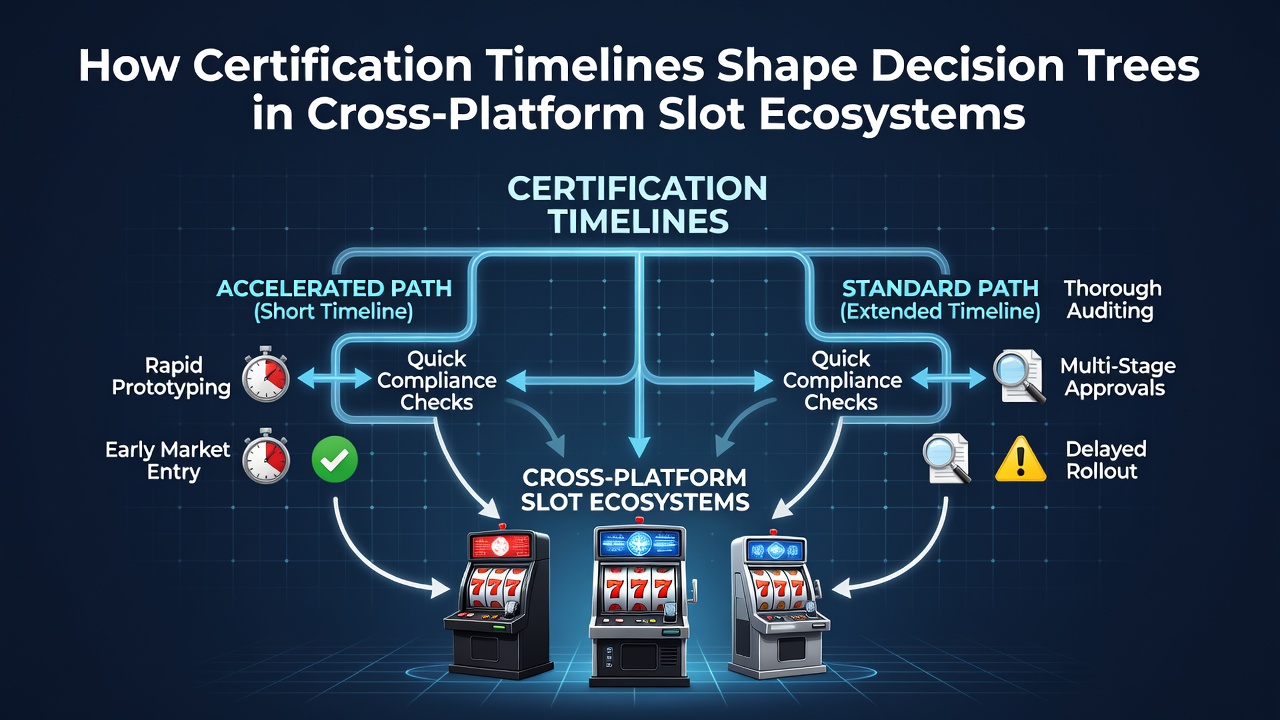
Certification timelines for slot games have grown into a central factor that determines how developers construct decision trees for cross-platform ecosystems, where the same title must function identically on mobile devices, desktop browsers, and dedicated terminals while satisfying regulatory standards in multiple jurisdictions. These timelines, which often stretch from three to nine months depending on the testing laboratory and regional authority involved, compel studios to design modular decision trees that separate core random number generation logic from platform-specific payout adjustments and bonus triggers, allowing updates to one branch without restarting the entire approval process.
Certification Processes and Their Structural Demands
Regulatory bodies such as the Nevada Gaming Control Board and the Malta Gaming Authority require extensive verification of fairness, security, and mathematical integrity before any slot title reaches players, and the duration of these reviews directly influences architectural choices in the underlying decision trees. Developers respond by embedding conditional nodes that isolate variables subject to frequent regulatory scrutiny, such as volatility settings or progressive jackpot contributions, into separately certifiable modules that can be swapped or recalibrated once initial approval clears. This approach reduces the need for full re-testing when minor platform optimizations occur, particularly when an Android build requires different memory handling than an iOS version.
Data from testing laboratories indicates that titles with deeply integrated decision trees experience certification delays averaging 40 percent longer than those built with segmented logic, prompting widespread adoption of tree structures that prioritize reusable subroutines for elements like symbol weighting and reel mapping. Observers note that this segmentation also supports simultaneous submissions across regions, where one jurisdiction may approve a configuration while another requests adjustments, without halting deployment on already cleared platforms.
Cross-Platform Adaptations Driven by Timeline Pressures
In ecosystems spanning multiple operating systems and device types, certification timelines force teams to anticipate platform-specific constraints during the initial decision tree design phase rather than retrofitting after approval. For instance, mobile environments often impose stricter limits on real-time data calls for progressive systems, leading developers to pre-load decision branches that handle offline calculations while maintaining synchronization points that regulators can audit independently. This pre-planning becomes essential when a single title must clear testing in both North American and Asian markets, where requirements for return-to-player disclosure and audit logging differ substantially.
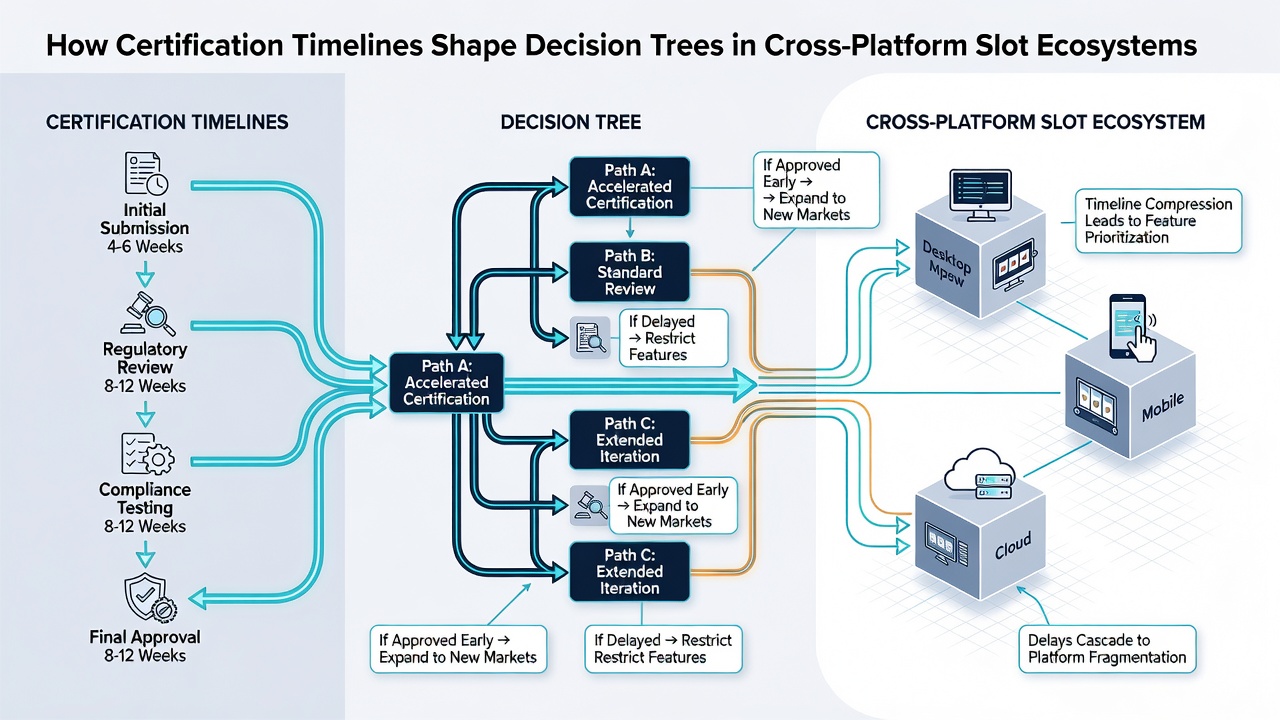
Research compiled by Gaming Laboratories International shows that projects incorporating platform-agnostic decision nodes from the outset achieve certification sign-off in an average of 22 weeks, compared with 31 weeks for those developed sequentially. Such findings have encouraged studios to map regulatory checklists directly into their tree architecture, placing high-scrutiny functions like bonus round triggers behind certification gateways that activate only after laboratory sign-off. The result is a workflow where decision trees evolve in parallel with compliance documentation, rather than serving as static code that must be frozen months before launch.
Effects on Update Cycles and Regional Rollouts
August 2026 saw several major operators coordinate staggered releases of cross-platform slots that relied on pre-certified decision tree modules to meet varying state and national deadlines, illustrating how timeline management now dictates release calendars. When a new jurisdiction introduces fresh encryption standards mid-development, teams can isolate the affected nodes, submit targeted amendments, and maintain momentum on unaffected platforms without restarting broader testing. This flexibility proves especially valuable for live content updates that respond to player behavior data, since only the modified branches require fresh review rather than the entire game build.
Industry reports from the European Gaming and Betting Association highlight that operators using segmented trees reduced average time between content refreshes by 35 percent in the first half of 2026, while still satisfying audit requirements from multiple authorities. Decision trees therefore function less as rigid hierarchies and more as living frameworks whose branches can be pruned or extended according to certification feedback loops.
Conclusion
Certification timelines continue to shape the evolution of decision trees in cross-platform slot ecosystems by rewarding modular designs that accommodate sequential regulatory approvals without sacrificing consistency across devices. Developers who align tree architecture with laboratory workflows gain measurable advantages in release speed and regional adaptability, while those relying on monolithic structures face extended review periods that limit their ability to iterate on player engagement features. As regulatory environments diversify further, the interplay between approval durations and algorithmic structure is expected to remain a defining element of how slot titles reach and retain audiences across platforms.